Introduction
Think small town England. Picture a quiet and rural East Anglian market town, transformed by 1960s social planning into Thetford - a small island of working class London, set in a rural East Anglian sea. Forgotten by the social planners for thirty years, bypassed by migration from either the Caribbean or from Asia, this predominantly white English new-working class borough arrives into the 21st century equipped with CCTV, Burberry and burnt out cars. Now try and imagine that thousands of migrant workers from Portugal, Eastern Europe, and elsewhere suddenly descend on this small English town.
I am using this website to provide locals with information. There was no consultation process, no formal introductions. While urban areas of the UK have in the past experienced waves of immigration from Asia, East Africa, and the Caribbean - the rural East is now experiencing immigration for the first time for centuries - a new immigration from Portugal and Eastern Europe. This is an economically driven migration that simply happened. It is not restricted to Thetford, or even to Norfolk. And the story has not ended, it's still continuing to produce new changes - it is local social history in the making.
Background
Thetford is a small town that lies in the south-west corner of the County of Norfolk. Before 1952, it was still a quiet little rural market-town, with a tiny population of only 4,500. The Town Development Act of 1952 allowed local authorities to approach London authorities, and to make a number of agreements. Parts of London were overcrowded, and the London authorities wanted to encourage people to move out of those areas, to newly developed areas outside of London. Thetford Borough Council formed a partnership with the London County Council. Large council house estates were built in the fields and heaths on the edge of town, and people moved out of London to fill them. Soon the newcomers from London outnumbered the original East Anglian population. Employers followed, and Thetford became a local centre of small-scale manufacturing industry. Not all of the indigenous inhabitants were happy about the arrival of the London families, but never-the-less, it lifted Thetford out of what had been a long state of stagnation. This expansion of the town continued until about 1974.
By the 1990s, the population of Thetford stood at around 19,500. It was recognised that it was an unusual town for the area - a new-working-class town with levels of social and health problems not normally found in rural East Anglia. Many young people still kept a London identity - accents, football club loyalty, etc. East Anglians outside of Thetford considered it to be the place where the Londoners live. The population relied mainly on employment in manufacturing, and on the firms in the town that had arrived with the expansion out of London. However, the 1980s and 1990s were sometimes difficult for these type of industries, and the town sometimes suffered from levels of unemployment.
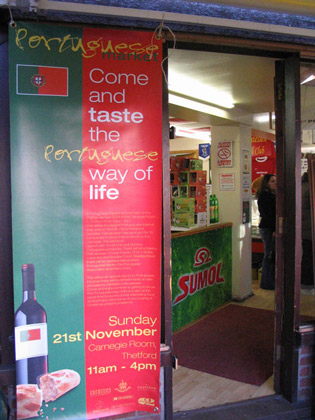
During the late 1990s, something strange started to happen. A slow trickle of new faces started to arrive in the town. This new wave of newcomers - only slight at first, were not from London. They were from abroad. By 2004, the media was suggesting that there may be as many as 6,000 Portuguese-speakers in the Thetford area - there are Portuguese cafés, restaurants, delicatessens, a bar, even a hair-dresser in town! Is Thetford now becoming the place where the Portuguese live?