Flint Flake Identification Guide
The Dorsal Surface
The dorsal surface is the back or outer surface of the flake – that formed part of the surface of the core before the flake was struck off from it. When a knapper first selects a nodule of flint for working on, it is covered by a natural white to brown thin skin called cortex. Consequently, the first flakes to be struck off the nodule, as it is fashioned into a workable core, have cortex across their dorsal surface. Flakes with a cortex-covered dorsal surface are termed primary flakes.
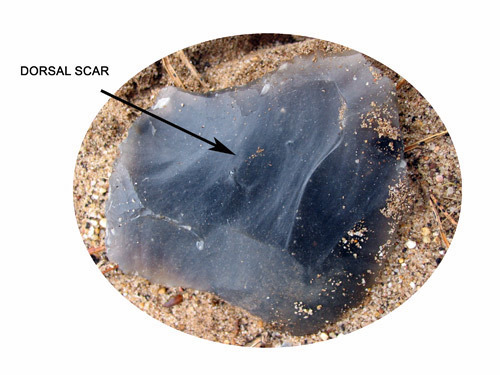
The below example is clearly cortex-free, and so is a secondary flake. Instead of cortex, this dorsal surface has the scars of previous flakes that were removed from the core when this flake still remained a part of it. These scars are called dorsal scars and along with the ridges that border the scars – they are unmistakably knapped by humans.
Grime's Graves Flint
The people who lived in the Brecks district between the ending of the last Glacial Age and the arrival of iron tools and technology were in a privileged position as far as raw knapping material goes. Breckland is home to the best source of flint material in the whole of the British Isles. In particular, the mined floorstone flint from the Grime's Graves area north of the Little Ouse is proclaimed by modern knappers as amongst the best anywhere in the world. Not only did it spawn the most remarkable late prehistoric flint mine complex in Europe, but workable outcropped flint could be found almost everywhere in the district. In addition to being highly suitable for knapping – the best local flint is translucent, glass-like, sharp, and beautiful.
The value of this flint did not stop with the introduction of iron. It became the source of the local vernacular tradition. Churches, priories, and warrener lodges were built or faced with it for miles around – along with many local houses, farm buildings, and cottages. The development of the flintlock gun heralded another revival for local knappers. The old mining methods of Grime's Graves were reinvented at Lingheath, Brandon, as miners supplied a local industry that produced the flints for the guns. Brandon blacks, as the gun flints were called, supplied the British Army during the Napoleonic Wars.