Survey Methodology
Exposed Soils
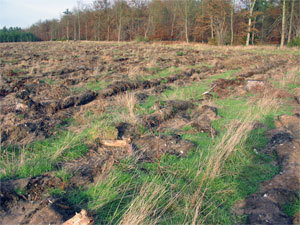
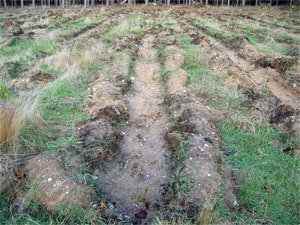
A linear method of field walking was designed, suitable both for the pine forest environment and the project aims. The method had to be viable for a single surveyor working alone. Transects, or lines, are walked at regularly spaced intervals along the recently cut planting furrows of restocked pine forestry compartments. These furrows are shallow trenches cut through the forest turf by a plough mounted on the front of a tractor. These transects were each divided into 20-metre-long stints, measured by a measuring wheel pushed along during the survey.
The transects are usually spaced apart to a default of 40 metres. However, if conditions permit, the transect frequency is occasionally increased to a spacing of 30, 20, or even 10 metres. This, along with the viewing width, directly affects the sample percentage – the actual proportion of the survey area walked and searched.
Collections
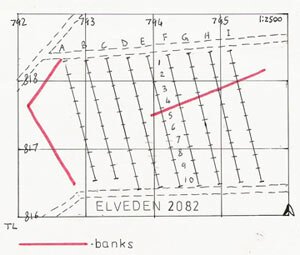
All recognised artefacts are collected, apart from burnt flints and modern tile or brick. Finds are washed, coded with a transect/stint number, and bagged. I catalogue the finds alongside eight-figure grid references. A survey plan at a scale of 1:2500 is attached, and then the finds are despatched to the county records officer for a second opinion and for entering onto the Site and Monuments Record (SMR).
The following figures are calculated for each survey: survey area, sample percentage, sample area, grid reference, lithic density (the density of struck flints), and burnt flint density. Fieldwork is suspended from late February to mid-September to prevent the disturbance of breeding birds, particularly ground-nesting woodlarks within the restocked compartments.
After the local government archaeologists have added the records to the SMR, I collect the finds. Eventually, I plan to deposit all of the finds from across the various projects together at a single public repository, so that they can form a comprehensive reference collection for the Thetford Forest area.
Surveying by GPS
I have introduced a handheld GPS (Global Positioning System) receiver since resuming surveys in 2006 following a six-year break. GPS data is fed to the Gartrip program for recording, analysing, and digital mapping. I can plot and verify grid references by downloading my tracks and waypoints onto a digital map. Survey map plans can also easily be created by drawing the transects directly on top of the displayed tracks and between waypoints.
I am now experimenting with using the GPS as a measuring tool for spacing out transects and measuring stints. This would eliminate the need to drag the measuring wheel across rough terrain or stake out long tapes – surface-collection linear sampling by handheld GPS!
Case Example: Surface-Collection Survey (SCS) Program
Methodology Statement: All transects were spaced 40 metres apart unless stated otherwise. Stints were strictly 20 metres long. Spatial measurements were determined by tape or cyclometer. Soil types and landscape facets were correlated with W. Corbett's soil map of Thetford Forest (Breckland Forest Soils 1973).
Forest-Walk 19 – Forestry Comp Brandon Park 2045/2046
Suffolk SMR: BRD 153 | Parish: Brandon | Date: 31/08/98 | Survey Area: 3.04 ha | Sample Fraction: 2.75% | Centre on: TL 7792 8365 | Soil: Methwold/Worlington: shallow and partly calcareous slope brown earth | Height OD: 20 to 25 metres.
- 3 abraded sherds of Roman pottery
- 9 abraded sherds of Medieval pottery
- 26 retouched or notched flint flakes
- 112 flint flakes
- 5 flint waste cores, 6 burnt flints
This survey produced by far the highest flint count of any forest-walk to date. Many of the flakes display edge wear and light retouch or notching. Colin Pendleton regards 68 of the flakes as 'utilised'. The workmanship is very poor, and the hinge count is high. Very High Lithic Density: 17.11 per are | Burnt flint density: 0.76 per are.
Expert Notes (Colin Pendleton, Suffolk C.C.): Degree of patination variable. Very poor standard of workmanship, squat flakes and numerous hinge fractures plus degree of re-utilisation of previously patinated flakes suggests residual earlier (Neolithic?) assemblage on principally Late Bronze Age / Iron Age site.
Forest-Walk 20 – Forestry Compartment Elveden 2082
Suffolk SMR: ELV Misc | Parish: Elveden | Date: 1/10/98 | Survey Area: 5.28 ha | Sample Fraction: 3.33% | Centre on: TL 7941 8174 | Soil: Santon/Worlington deep upland brown earth | Relief: Flat upland | Height OD: 50 metres.
- 3 sherds of undated pottery
- 10 flint flakes, 1 burnt flint
A previously unrecorded, low-lying and poorly defined bank was detected within the surveyed area, stretching from TL 7939 8175 to TL 7956 8181. Low Lithic Density: 0.57 per are | Burnt flint density: 0.06 per are.