Flint Flakes Tour
Two Flint Flakes in Exposed Soils
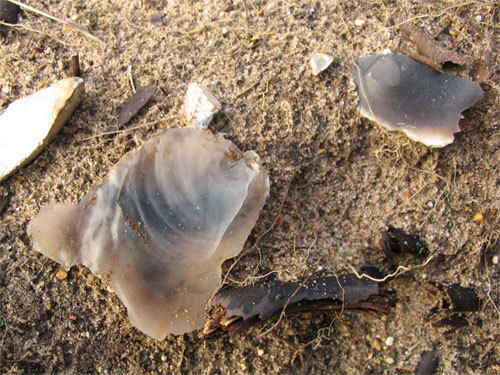
Not at all unusual to find prehistoric flakes so close together in Thetford Forest. The bigger one on the left is lying on its ventral surface – its back (dorsal) is facing us, and you can see the scar of a smaller flake removed from it while it was still part of a core. The smaller flake on the right is lying on its dorsal surface, and a bulbar scar can clearly be seen.
Dorsal, bulbar, ventral, etc. are simply terms used to describe the different features of worked flint. The ventral surface is the underbelly of a flake – where it was sheared off a prepared flint core. This belly isn't flat – it is slightly bulbar, and sometimes bears a scar of the impact – a bulbar scar. The dorsal surface is the back of the flake. If it is one of the first flakes struck from a core during its initial preparation, it bears the hard outer skin of a natural flint nodule called cortex, and this makes the flake a primary flake.