Flint Flake Identification Guide
The Ventral Surface
Flint that has been knapped by humans has been struck by impact – and sometimes by pressure (pressure flaking is used to back or finely retouch flint tools). Striking a flake from a flint core is called conchoidal fracture. Nature rarely makes flakes this way – it can do, but natural flakes are usually made by thermal or starch fracture. Natural conchoidal flakes can occur, and may also be accidentally created by heavy human transport moving over the surface, but generally speaking, they can be distinguished by experienced eyes. When struck flakes appear in numbers – some with tidy platforms, retouch or signs of utilisation – there is no mistaking them for natural or accidental phenomena.
A piece of flint that has been struck off a core by sharp impact can be identified by its conchoidal characteristics. The surface of a flake that has been struck from a core of flint is called the ventral surface.
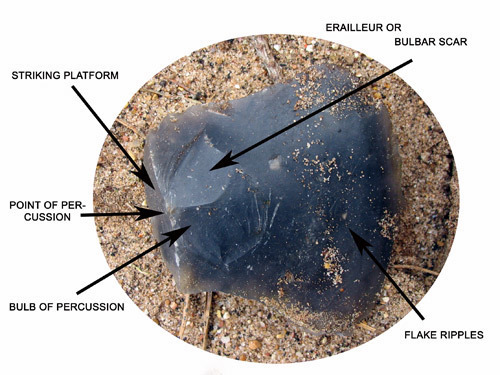
The point at which a hammer hit a flint and struck the flake from a core is called the point of impact or percussion. The energy dissipated from this point in a cone-like manner, which left a bulb of percussion on the ventral surface below the point of impact. Sometimes, it also leaves a small scar on the bulb, called the eraillure scar or bulbar scar. The impact can also leave small splits or fissures radiating away from the point of impact. Finally, the impact often leaves ripples fanning away from the bulb – this flake doesn't have fissures or ripples, but you will notice them on some of the following examples in this gallery.
The flake was struck off from a prepared flint core. Part of the core striking platform remains on the proximal (striking) end of the flake as the butt.
Flakes can be struck either by a hard hammer (a hammerstone), or by a soft hammer (antler or bone punches). A hard hammer creates larger bulbar scars, prominent ripples, and hinge fractures – it is less controlled and creates a more curved, squatter flake. Striking a flake further into a striking platform with a hard hammer creates thicker flakes – suitable for retouching into scrapers. Skilled use of a soft hammer can create flatter, longer flakes with a flat, sharp distal end. Using a specially prepared flint core, soft hammers, and indirect percussion (striking flint via a punch), a skilled knapper can create long, thin, slim flakes with parallel sides termed blades.