Flint Flake Identification Guide
From the Side – Lateral Edge
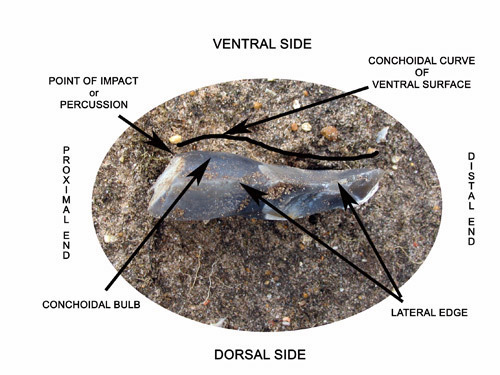
Turn a flake on its side, and you can often see that distinct conchoidal curve – I often rub the ventral surface of a suspect flake to feel for that telltale conchoidal bump coming off an impacted end. The struck or impacted end of the flake is called the proximal end. The far end of the flake away from the point of percussion is termed the distal end. The edges of the flake – often still sharp – are called the lateral edges. This photo shows a flint flake up on one of its sides or lateral edges – note the outlined conchoidal curve. This curve is more pronounced in flakes that have been struck with a hammerstone rather than with a soft hammer. This is a thick flake that was struck at a point well inside the edge of the striking platform.
What Were Flakes For?
Some flakes were not removed from prepared cores – instead, they were removed as waste flakes during the production of a bifacial core tool such as a flint axehead. In this case, they are rather like the shavings in a carpentry shop. They tend to include bulky flakes, lumps, chips, and primary flakes.
In other cases (and I suspect the majority of cases), the flakes were struck from flint cores that were prepared with the intention of creating usable flakes themselves. The knapper would prepare a core that she or he could use as a supply of flakes – they were not waste, but in this case, the product. So what were they for? Ask any modern-day survivalist – a prerequisite of life is a sharp-edged tool – with that you can butcher meat, scrape skins, chop vegetables, peel fruit, make cooking devices, cut rope, trim hair, make shelters, traps, hunting weapons, prepare clothing, harvest grain, etc.
Phil Harding has suggested that in the pre-metal world, everyone would be capable of some level of knapping – man, woman, boy, and girl. It was a prerequisite of life. People would carry small prepared cores with them, and a hammer, maybe a punch or tine. When they needed a fresh sharp edge – they would strike off a few flakes until they had one that suited the job.
Flakes were also the source of the majority of more formal tools – arrowheads, awls, scrapers, piercers, flake-knives, spoke-shaves, etc. When no more flakes could be economically extracted from the core, it was discarded as a waste core – rather like the core of an apple.