Manure-Scattered Ceramics
Their Distributions across Thetford Forest
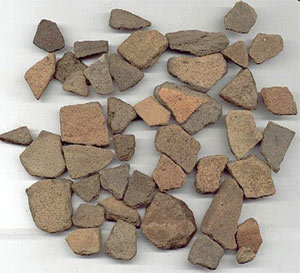
Light background scatters of small abraded sherds of pottery are often detected during field surveys. Archaeologists usually consider such finds to represent so-called manure scatter. Until the recent introduction of refuse collection services and modern fertilisers, household and courtyard waste was often spread onto arable fields close to settlements. This not only kept settlements clean and tidy, but also provided a valuable fertiliser for crops. Rubbish tipped onto the manure heaps included floor sweepings and broken pottery from the kitchens. These manure and garbage heaps would be carted out to the fields, to be ploughed into the soil. Although the manure quickly degraded into the ploughsoil — the sherds of pottery often survive to the present day as manure scatter.
The Thetford Forest Survey
Archaeologists frequently ignore manure-scattered ceramics in the top soil — homing in on the clusters of large sharp fragments and sherds of pottery that are more likely to represent 'sites' of settlement or industry. Rather than ignore the waste scatter, I have chosen to record it as data for comparison. Breckland has extremely variable soils that may have been exploited in a variety of ways in the past, and as the following evidence suggests — not just as pasture.
Prehistoric Manure Scatter?
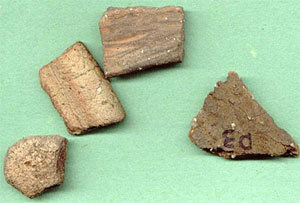
Several sherds of Bronze Age pottery were recovered during forest-walks 1 to 3 on the edge of uplands at West Stow. The presence of any prehistoric ceramics here was very unexpected — five kilometres from a river, and on brown earth soils on the edge of uplands.
Prehistoric pottery is very frail, and has a poor survival rate in acidic Breckland topsoils, which are prone to both frequent ground frosts and high temperatures under the sun. When they do occur, they are often automatically associated with 'settlement'. However, could the sherds have been deposited with manure, as in later ages? The presence of any prehistoric ceramics on these compartments was very unexpected; the location seems unattractive for either cultivation or settlement. However, the surveys also recovered evidence of cultivation here both during the Roman period and in recent centuries.
Romano-British Fields
Seven areas of the Forest have so far produced Roman manure scatters. They occur on a variety of soils. These include not only shallow slope soils, but in a number of cases, also on the deeper brownearths of the uplands. A particular area of interest is the Kings Forest area, where Roman manure scatter turns up on the uplands of West Stow and Wordwell in Suffolk.
Medieval Fields
Five areas of the Forest have so far produced medieval manure-scatters. In each case, this has occurred on the kind of landscape where past cultivation would be expected — on the shallower calcareous soils of the slopes, within the river valley zones. However, I would stress that soil type appears to be more important than distance from water — medieval manure scatter has turned up on the farthest slopes from the modern rivers.