Romano-British Archaeology
Roman Site 32349 and Other Finds
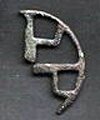
The site of a previously unrecorded Roman settlement was discovered in the Forest during the initial phase of the project. The settlement probably covered around 3 hectares, and included at least one substantial building, with a tiled roof. Finds suggest that at least one building (possibly a bath house?) had a hypocaust heating system. There is plenty of evidence of domestic activity – with food preparation bowls (mortaria), quernstones for grinding flour, storage jars, and tableware. With a few exceptions (a little Samian, and one dolphin brooch), the finds are overwhelmingly late in date, and its main use appears to have been between 250 and 415 CE (or later).
Retrospective Note (2026): My musings in 2006 regarding the lack of traditional Early Saxon wares alongside the dense presence of calcite-gritted pottery at Site 32349 target a classic archaeological dilemma. Two decades on, advanced paleogenomics and aDNA sampling across East Anglia have completely revised this horizon. We now know that the collapse of Roman administrative coin supply in 408 CE did not trigger an instant vacuum or immediate overnight population replacement. Instead, deep continental genomic turnovers show a complex, multi-generational integration. The persistence of local calcite-gritted wares alongside late coin limits marks the final, resilient generations of Romano-British life adapting to an increasingly decentralised, post-imperial landscape right here in the Breckland wildwood.
Official County Record: NHER Number 32349
Record Type: Find Spot & Roman Settlement (Multi-period)
Summary: Systematic fieldwalking and subsequent metal detecting between 1996 and 2002 identified a substantial, previously unrecorded late Roman settlement covering over two hectares. The recovery of broken box flue tile (hypocaust heating) and tegula fragments confirms the presence of at least one significant masonry building structure.
- 1996/1997 (Fieldwalking – P.W. Brooker): Initial discovery during tree restocking. Recovered over 600 Roman sherds including greyware, Oxfordshire mortaria, Much Hadham, East Anglian Colour Coated, and Nene Valley Colour Coated wares. Also yielded broken box flue tile, quern fragments, and early prehistoric debitage.
- 2000–2002 (Metal Detecting – I. Hinton): Systematic recovery of 112 Roman coins, including 4 silver siliquae representing a potential late coin hoard. Metal objects included a dolphin brooch, a two-piece Colchester brooch, and extensive metal-working debris.
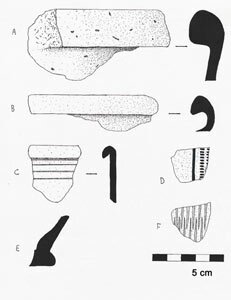
I discovered this site in 1995/6 during the run up to the SCS Project, before I had developed a proper methodology. The site was quickly disappearing under fresh vegetation, following restocking. The site is located on a gravel terrace, adjacent to a river in the Thetford area.
Pre-Roman Finds
Prehistoric struck flints litter the site, as would be expected in such a location in Breckland. Find types suggest a wide variety of dates for deposition – from the Late Mesolithic through to the Bronze Age or later. Removed lithic finds included 2 flint convex scrapers, 3 flint micro-blades, 1 flint flake knife, 1 flint piercer, and 1 keeled flint waste core.
Romano-British Settlement
Clusters of late Romano-British pottery, tiles and quern fragments are scattered, often at high density over an area of three hectares. The finds suggest either a 'villa' type estate centre, or alternatively, a small nucleated village settlement, that existed here sometime between the mid 3rd century and the early 5th century.
Roman Finds Included Examples of:
- Tegula tile and box-flue tile
- Grey wares (including possible Nene Valley and Nar Valley types)
- Calcite gritted (including 'East Midland cooking jar' types)
- Much Hadham; Pale oxidised; Nene Valley Colour-coated
- East Gaul Samian (only 1 sherd); East Anglian Mortaria; Oxfordshire Mortaria
- Several fragments of millstone-grit quernstones
Metal Finds on Roman Site 32349
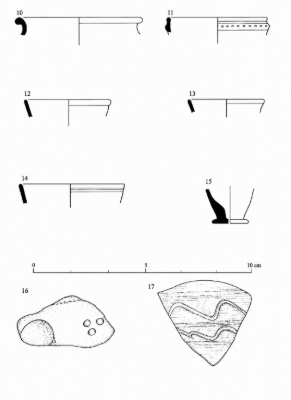
With permission of Norfolk Landscape Archaeology and the Forestry Commission, local metal detector enthusiast Ian Hinton carried out a metal detection search of the Roman site 32349. He recovered: circa 70 Roman coins including 5 silvers; a bronze finger ring; a bronze domestic blade; a broken brooch; probable metal working slag; various iron nails; and more Late Romano-British pottery. Initial analysis suggests a very late date, after CE 395 for the latest coins, probably as late as AD 408.
Post-Roman Settlement
No sign of so-called squatter occupation – no Early Saxon pottery on this late Roman settlement, no Anglo-Saxon metal finds. However, there were large amounts of calcite-gritted potsherds – which have been associated by some with a Post-Roman 5th century period.
Roman Breckland
I am measuring the densities of Roman manure scatter across the Forest as a whole. The evidence is suggestive of a widespread cultivation of areas of the Brecks during the Roman period, with Roman dated manure scatter turning up on some unlikely soils, normally reserved for heath. I suspect that the Roman period saw some significant forest clearances in the Brecks, driven by high demand for fuel to feed kilns, forges, salting pans, and hypocausts.