Small Finds – Neolithic Axehead
Santon Warren, Compartment 3083, Lynford, Norfolk
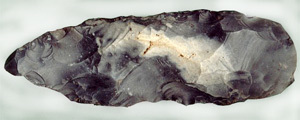
This intriguing artifact was recovered during systematic forest-walk survey number 37 in January 2000. It represents a highly unusual morphological example of a small flint axehead. Upon initial surface recovery, its general dimensions and rugged flaking led me to consider whether I had discovered my first Mesolithic tranchet axe. However, closer macroscopic inspection reveals it to be a highly informal, expedient axehead dating to the Neolithic period.
The total abundance of exceptional quality native chalk flint in this specific micro-region of the Breckland sands likely fostered a local lithic economy of "expedient knapping." With high-grade raw material readily accessible right beneath the turf, there was little pressure to invest immense labour into creating formalized, polished prestige tools. Instead, a craftsman could quickly fashion a rough, informal, and essentially disposable clearing tool for immediate tasks.
Field Methodology & Assemblage Analysis
Over the course of 22–23 January 2000, a total of 74 individual stints were walked systematically across this non-destumped forestry compartment. Survey visibility conditions were good to average, with a strictly controlled viewing width set at 110 cm. The remarkably low percentage of flake utilisation strongly implies that this location served primarily as a primary knapping station rather than a long-term processing site.
Furthermore, the detection of a distinct, localised cluster of 16 burnt flints (pot boilers) concentrated at grid coordinate TL 8376 8753 A strongly points to a transient domestic hearth structure positioned right on the dry valley margin, just a short walk from the freshwater resources of the Little Ouse.
- Location: Santon Warren, Compartment 3083, Lynford C.P., Norfolk.
- Spatial Coordinates: Centred on TL 8372 8765 C (Elevation: 14 to 25m OD).
- Topography: East and south-facing slopes of a secondary dry valley; 250m north of the River Little Ouse.
- Survey Footprint: 5.92 hectares surveyed with a calculated Sample Fraction of 2.75%.
- Quantified Assemblage: 1 flint axehead, 1 plano-convex knife, 16 retouched/utilised flakes, 102 unmodified flakes, 2 waste cores, 16 burnt flints, and 3 prehistoric pottery sherds.