Introduction and 1995 to 1997 part I
Preparatory Finds in the Forest during 1995 to 1997
Introduction
I began making artefact collections in Thetford Forest during 1995, with no experience or guidance. The earliest of these forays focused on the private collection of flint implements, although I took care to record at least approximate grid references, and later handed them in for recording on the SMR. By 1997, I was keen to improve my methods, and to make more archaeologically useful surveys.
I designed the aims and methodology of this research project while studying field archaeology and landscape history part-time with the extra-mural department of the UEA. The methods of previous surveys were studied, including those of the Fenland Project, the Breckland Archaeological Survey, and Alan Davidson's survey of Illington, Norfolk. A compilation of essays published by the University of Sheffield under the title Archaeology from the Ploughsoil (edited by Val Kinsler 1985) were of particular use.
However, I could not have conducted the research project without the experience that I gained during the following collections, hence the naming of this section as Preparatory Finds, and their inclusion here at the beginning of this report.
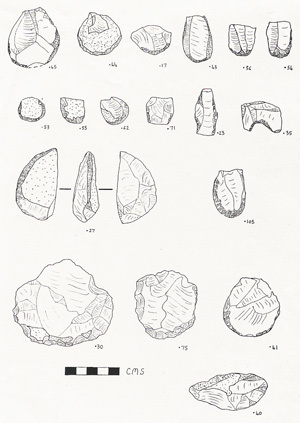
Prehistoric Flints, Thetford Warren
Forestry Compartment Downham 5040
- Norfolk SMR: 32344
- Parish: Thetford
- Centre on: TL 847 847
- Water: 400 metres to the Little Ouse
- Height OD: 15 to 25 metres
No previous collections were recorded on the SMR from this location. Finds included:
- 1 transverse flint chisel arrowhead (late Neolithic).
- 1 broken unifacial laurel leaf (Neolithic).
- 8 flint scrapers, assorted types (including button, round, side, and general convex).
- 1 flint rod/fabricator.
- 1 flint pick/piercer.
- 1 patinated unmodified blade.
Although the lithic density was not measured, it appeared to be quite high. No ceramics were collected in 1995. However, I revisited the compartment during 1998, and recovered a number of sherds (see Subsidiary Finds No 8 further on).
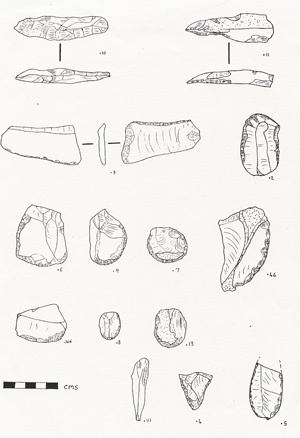
Prehistoric Flints, Santon Warren
Forestry Comp Lynford South 3022
- Norfolk SMR: 5661
- Parish: Lynford
- Centre on: TL 823 892
- Water: 1.4 km from Little Ouse
It is here that I accidentally stumbled on one of the old flinter's hunting grounds, next to Grimes Graves. Unfortunately, this was before I knew how to measure lithic densities, as this site certainly contains a very high density. It produced a large collection of flint implements for me, all which were later lent to Norfolk Museum Services for recording. Generally speaking, the implements were of a late prehistoric date, with a large number of piercers / borers, and scrapers. Implements were often based on large fresh-looking flakes of dark grey flint, suggesting an abundance of raw material. Finds included: borers/piercers; scrapers (including button type); flake knives; waste cores; hammerstones; a rod; core rejuvenation flakes; and combination tools. A friend recovered a barbed and tanged arrowhead. No ceramics were collected.
Prehistoric Flints and Roman Ceramics, Near Thetford Warren Lodge
Forestry Compartment Downham 3011
- Norfolk SMR: 25968
- Parish: Thetford
- Centre on: TL 836 845
- Water: 1.1 km from the Little Ouse
Finds included:
- 1 sherd of ?Iron Age pottery.
- 11 sherds of Roman pottery (grey wares and 1 East Gaulish Samian bowl rim-sherd).
- 1 broken unfinished ?leaf arrowhead (Neolithic).
- 1 transverse oblique flint arrowhead (late Neolithic).
- 1 broken triangular flint arrowhead (late Neo - EBA).
- 9 flint scrapers (various types including button).
- 1 large flint ?microburin.
- 1 flint hammerstone.
Three arrowheads could indicate that this was a favourite hunting spot, but the unfinished example could alternatively suggest the nearby presence of settlement. Although I was not yet experienced in measuring densities, I would imagine that this compartment would have produced a fairly high lithic count, although not as high as on site 5661. The presence of so many abraded Roman ceramics probably suggests that this survey area formed part of an arable field cultivated during the Roman period (possibly the 3rd century AD). No medieval ceramics were found.