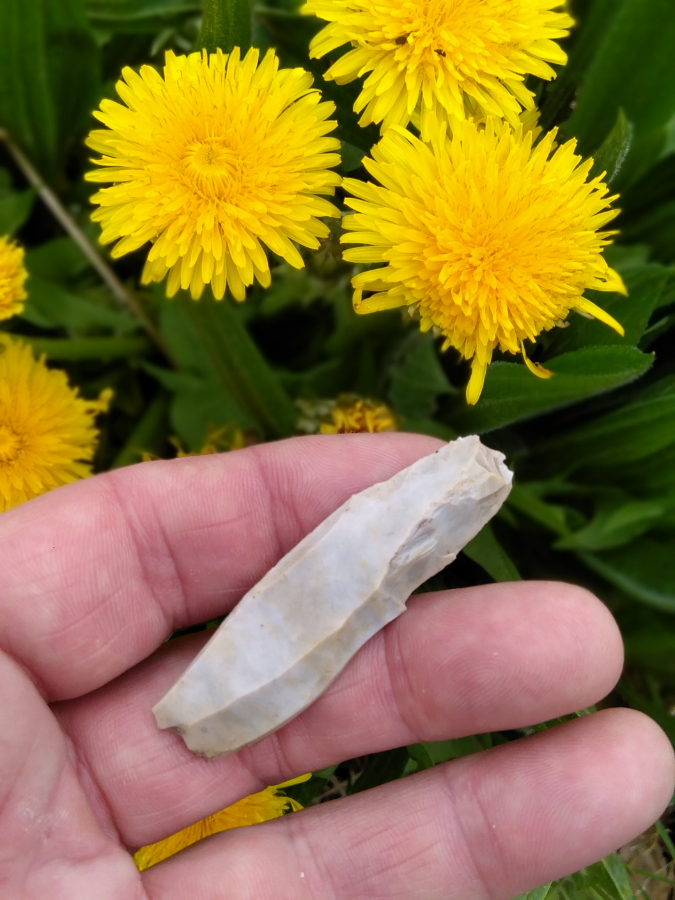
Small Finds: Patinated flint blade
I picked this up at Two Mile Bottom, Thetford in 2023. This site is renowned for Mesolithic finds. It could indeed be of Mesolithic date. It is very much a crafted blade albeit not a microlith.
During the late 1990s it was trendy to describe finds such as this as evidence of Late Mesolithic to Early Neolithic transitional. Because back then, any suggestion of population replacement accompanying new technology was regarded as incorrect, under the Pots are not people mantra. There was nothing wrong with that chant, except that it was overplayed.
Archaeo-genetics, a passion of mine, has come to blows with the transition hypothesis. The evidence of Ancient DNA as it currently stands in 2026, supports a different tale. The Mesolithic hunter-gatherers of Britain belonged to a genetic population known as WHG (Western Hunter-Gatherers). They were distinct from the new farmers, the Neolithic settlers. These new settlers were a mixture, with both DNA from WHG hunter-gatherers on the Continent, and from Anatolian Neolithic farmers from the Middle East. We call this mix, the EEF (Early European Farmers). There was little transition. Pots sometimes do represent new people. Sometimes.