Small Find – Broken Flint Sickle or Dagger
Thetford Warren, Norfolk
I discovered this highly significant broken flint piece purely by chance. I had arranged to meet a friend near the recorded Roman site (NHER 32349) within the open, sandy terrain of Thetford Warren, Norfolk. Just as I approached our meeting point, my eye caught the unmistakable flash of deliberate, high-quality prehistoric workmanship exposed in a patch of disturbed forest soil!
This artifact is a beautifully executed fragment of what was – or was intended to be – a high-status piece of prestige lithic technology, most probably a crescentic sickle or a ceremonial dagger. Neatly and meticulously pressure-flaked across all of its surviving surfaces, the tool can be confidently dated to the Late Neolithic horizon. Found on the lower slopes and gravel terraces of the valley, the findspot sits just 500 metres from the modern course of the River Little Ouse.
While a sickle fragment typically evokes images of early agricultural grain-harvesting, tools of this exceptional calibre were equally vital for gathering specialised wild plants, reeds, and rushes along the river margins. Furthermore, given the immense labour investment required to achieve this level of invasive bifacial thinning, the piece may well have held immense symbolic or status value within the local community.
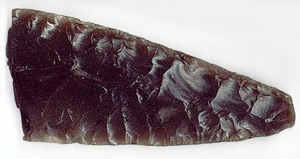
- Parish/Location: Thetford, Breckland District, Norfolk.
- Context: Opportunistic surface recovery from exposed forest soils on lower river gravel terraces.
- Topographic Elevation: Situated approx. 500m north of the River Little Ouse corridor.
- Spatial Associations: Immediately adjacent to the multi-period complex at Thetford Warren, close to the recorded Roman structural footprint of NHER 32349.