A Boundary Bank in Thetford Warren, Norfolk
NHER 33608
This page details a field survey of a linear earthwork that originally curved for some 700 metres, enclosing an area of gravel terrace and valley-bottom peat fen adjacent to the River Little Ouse. It is delineated on Ordnance Survey maps as a distinct dark feature running around the perimeter of an area named 'New Plantation'.
The boundary is completely absent from the 1805 Thetford Enclosure Map, but appears clearly as an established block of plantation on the 1906 OS 1:2,500 map. Consequently, this earthwork reliably dates to the nineteenth century and functioned simply as a standard woodland boundary bank.
Modern forestry operations continue to impact the preservation of the bank. In recent years, a 130-metre section was completely destroyed where it crossed a restocked portion of compartment 5040, leaving nothing behind but a bare sand-mark. A further eleven gaps have been cut through the bank: three for modern footpaths and eight for vehicular access during past timber harvesting.
Database Update & Historical Alignment (NHER 33608): Subsequent synthesis by the county Historic Environment Record has fully validated this fieldwork under monument record NHER 33608. Documentary research has tied this exact 700-metre curving bank to an asset survey from 1649 (held in the archives of Arundel Castle), which indicates that these earthworks delineate the historic boundaries of Shoringe's Meadow. The 2017 Breckland National Mapping Programme analysis of the 2015 0.5m airborne LiDAR data confirmed that the micro-topographical signature of the earthwork survives clearly on the forest floor. The Mesolithic microlith findspot is now tracked independently under NHER 59554.
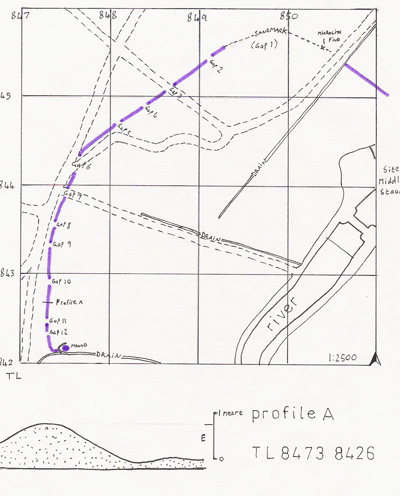
Crucially, a prehistoric microlith was recovered directly from the exposed sand-mark where the 130-metre section of the bank had been scrubbed out, located at TL 8504 8455.
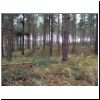
This thumbnail shows some of the undulating ridges, humps, and bumps visible within the embanked enclosure. Early airborne LiDAR data has begun to flag these micro-topographical variations, opening up fascinating questions about deeper landscape usage within the warren.