A Late Prehistory of Breckland
Retrospective: The Genomic Perspective (2006 vs. 2026)
A Note from the Author: The text below represents the baseline of archaeological thought when this survey portal was first published in 2006. In the more than two decades since, our understanding of British prehistory has been utterly transformed by the massive revolution in ancient DNA (aDNA) analysis, archaeogenetics, and human population genetics.
Where 2006 landscape archaeology saw localized, seasonal choices or gradual cultural transitions among static populations, we now recognize major continental genetic turnovers. The sparse "Earlier Neolithic" traces and slim patinated blades on these sandy soils mark the arrival of Early European Farmers (EEF) carrying Anatolian ancestry, largely replacing the original Western Hunter-Gatherer (WHG) lineages.
Even more starkly, the intense Late Neolithic activity at Grimes Graves and the sudden appearance of Beaker pottery align with a massive influx of Western Steppe Herder ancestry (predominantly Y-DNA haplogroup R1b-M269) around 2500 BCE. The "poor workmanship" and irregular, squat hinge-flakes noted in our later Bronze and Iron Age assemblages reflect a technology in decline as these genetically shifted communities increasingly turned to metal. This site stands as a living archive of how local landscape data fits into deep-time continental migrations.
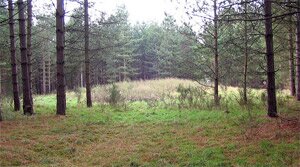
The Brecks
The Brecks offer something to every student of British Prehistory, whatever their specialist field – from the early humans of the Lower Palaeolithic – to the enclosures and hill forts of the Late Iron Age. The Brecklands have in recent years attracted a number of excavations of early human sites – usually in situ, including Lower Palaeolithic sites at Mildenhall, Lakenheath, and Elveden, and a now famous Middle Palaeolithic site recently discovered on the edge of the forest at Lynford, Norfolk. However, the focus of this article is on the later prehistory of modern human beings in the Brecklands area.
The sandy soils of Breckland are a mix of glacial silt, sand and gravel which vary in both depth and acidity. Aeolian sands were blown to Breckland during the last glacial maximum. Lowland Britain was still connected to the European continent via the Great North Sea Plain. During warm periods, bands of hunter-gatherers would have almost certainly passed through the area. A few Upper Palaeolithic flint finds left by these bands were recorded by flint collectors during the early 20th century. At the end of the Ice Age, the Brecklands would have attracted the attention of Early Mesolithic peoples, who simply would have walked here across the North Sea Plain, following the herds of wild animals. Towards the end of this period, the Plain flooded, and Britain became an island.
The Last Hunter-Gatherers? The Mesolithic
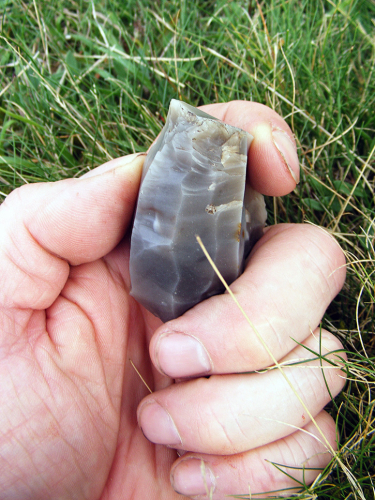
The Brecks district may have been attractive to hunter-gatherers during the Late Mesolithic (circa 6000 BCE – 4000 BCE), due to its proximity to the fen-edge and salt marshes, rich in wildfowl, eels, etc. The Brecks would have appeared as a range of sandy uplands, above the salt-marshes. Its wildwoods may have been lighter than on the claylands to the north, enabling the easier hunting of deer species. Microliths – the classic artefact of this period, have frequently been found in the Brecks, including along the Little Ouse Valley, and around the edges of the meres. Two recent excavations in different parts of Thetford (Redcastle Furze and Two Mile Bottom), have both produced Mesolithic flint-working sites. However, disappointingly, the project has found very few microliths, although small patinated blades, suggestive of a Mesolithic or Early Neolithic date, frequently turn up.
The Earlier Neolithic – Farmers and Monuments
Evidence of Earlier Neolithic (4300 BCE – 3000 BCE) settlement in the area is sparse. However, as previously noted, small numbers of slim patinated flakes and blade-like flakes frequently appear during the surveys, which could date to this time. Frances Healy suggested that much of Breckland may have been used for hunting. Perhaps the Brecks continued to be used for hunting by mobile groups based over a wider area, with cattle drovers grazing livestock on the better grasses of the river valleys – possibly as they were passing through seasonally to richer pastures along the fen-edge.
East Anglia has often been regarded as having rather fewer prehistoric monuments than other parts of the British Isles such as Wessex and Orkney. However, it is becoming apparent that East Anglia was the home of many earthwork monuments that have simply been ploughed and harrowed away by arable cultivation. Such a Later Neolithic (3200 BCE to 2200 BCE) ritual landscape has been discovered on the edge of the Brecks and close to Thetford Forest, at the Fornhams in Suffolk. The discovery was made by aerial photographic survey, and consists of crop and soil marks of a number of late prehistoric monuments, including a large cursus, two probable causewayed enclosures, hengiform marks, and nearby Early Bronze Age round barrows.
The Later Neolithic – Grimes Graves
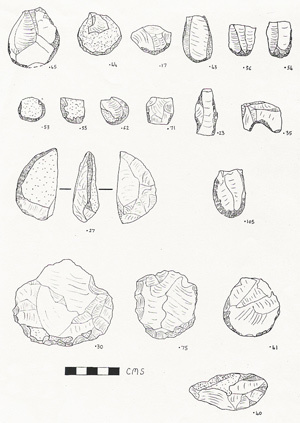
A large number of Later Neolithic flint arrowheads have been recorded here. Examples recovered during the Project include oblique and transverse types. The presence of these arrowheads suggests that hunting continued to play an important role in the local economy. Some groups that traditionally exploited these resources in Breckland probably lived along the Fen-edge to the west for part of the year. No earlier ceramics than Beaker ware (Late Neolithic – Early Bronze Age) were recovered from the surface during the surveys.
Breckland's best known late prehistoric monument is the Grimes Graves Late Neolithic/Bronze Age flint mine complex. The mines appear to have come into use towards the end of the Stone Ages, but were mined for the local high quality floorstone flint over many years, continuing through to the beginning of the Early Bronze Age. Four to five hundred shafts were sunk, at a rate of one or two per year. It has been estimated that each shaft would have produced some eight tonnes of flint nodules. The miners used picks fashioned from red deer antlers, and stone axes to dig the mines. It has been estimated that some 120 red deer would need to have been managed to keep the miners in picks, meat, and clothing at any one point.
There is plenty of evidence from excavations at the mines of ritual and ceremonial activities. The floorstone flint from Grimes Graves may have had some sort of special cultural value – when it was used, exchanged, given, a value that it came from somewhere special may have travelled with it. Lowering themselves up to a depth of 12 metres below the surface, and crawling along the low galleries that followed the floorstone seam, working by the light of animal fat candles floating in little chalk cups – the miners may well have felt that they were entering another world with a spiritual connection.
Frances Healy mentioned the existence of a Grimes Graves Belt of lithic scatters on the north side of the Little Ouse Valley across the parishes of Santon, and Weeting. The belt is not consistent, but there are a number of very high density flake scatters in that area – especially between the mines, and the river. It would be wrong to ignore a possible relationship between the scatters, and the mines.
The Bronze and Iron Ages
Many of the struck flints in the Brecks are very suggestive of a Bronze Age date – with some lumpy tools, hinge fractures, frequent miscellaneous retouch, irregular shapes. Early Bronze Age arrowheads found include barbed and tanged, and triangular types. Round barrows are common across the district, and new examples are still being recorded in the Forest. Several sherds of (probable) Bronze Age pottery were recovered during surveys on upland soils in West Stow, suggesting either non-riverine settlement, or prehistoric manure-scatter.
Midden remains of a Middle Bronze Age settlement that were deposited in shaft infills at Grimes Graves have been excavated, and analysis of the finds suggested that there must have been much settlement somewhere nearby. Cattle bones found in the middens suggested that they may have been dairy farming. The Drove track that cuts through Santon Warren, past local meres – between the Harling area and the Fen Edge, has long been considered to be a pre-Roman road. A recent excavation at Game Farm, Brandon uncovered a settlement, including enclosure ditches, gullies, and postholes for sub-circular houses.
It used to be thought that the Brecks heaths were created by Neolithic deforestation. However, modern landscape studies and pollen analysis suggest that deforestation was much more gradual – suggesting maybe, a more casual approach to cultivation than was once thought – with pastoralism possibly the mainstay of the local economy. Murphy suggests that deforestation of some uplands may have not occurred until the Late Iron Age or Early Roman periods.
There appear to be some similarities between barrow finds in the Breckland area, and those in Wessex – such as the finds in a barrow excavated at Little Cressingham – a crouched skeleton was buried with a grooved bronze dagger and gold sewn to the clothing. An exciting find was of the Whitehill bell barrow in the forest at Brandon. Bell barrows are more often found in Wessex, where they are usually dated to the Middle Bronze Age.
Iron Age archaeology is notoriously difficult to detect on the surface. A few sherds of Iron Age pottery were recovered, and a probable small riverside settlement was recorded. A so-called Hill Fort was believed to have been built at the bottom of the valley in Thetford during the Middle Iron Age. The enclosure was later incorporated into the defences of a Norman Medieval castle, whose earthworks are now located at Castle Hill Park, Thetford. A square enclosure, believed to be ritual and/or political was built at Barnham. This was abandoned in the 1st century BCE, about the time a new more extravagant enclosure was built on top of Gallows Hill, Thetford. This enclosure was almost certainly associated with the royal family of the Iceni tribal federation, and must have been involved in the rebellion against Rome led by Queen Boudicca. But that's history...