February 1999 to September 1999
Subsidiary Find 5: Early Medieval Pottery Cluster
Forestry Compartment Brandon Park 2055
- Suffolk SMR: BRD 152 | Parish: Brandon | Date: 27/06/98
- Survey Area: 4200 m² | Soil: Ground water gley soils | Height OD: 10m
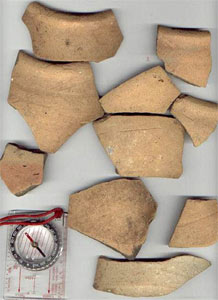
A reconnaissance survey revealed a very dense cluster of sherds all from mid 11th to late 12th century Early Medieval Ware (EMW) 'Ginger Jars'. The cluster is situated in a forestry compartment that had been clear felled and restocked recently. The sherds are very sharp, fresh looking and unabraded.
Suffolk Archaeology described the sherds as 'of an Early Medieval tradition; with buff-firing, sandy with some calcareous inclusions, generally leached out with occasional flint'.
The only other artefact found was a single fragment of lava quern stone. Andrew Rogerson suggested that the site could be a production centre.
4: Metal Detection at Thetford
Forestry Compartment High Lodge East 3117
- Norfolk SMR: 32785 | Parish: Thetford | Centre on: TL 851 830
I borrowed a Tesoro Laser B1 metal detector to search for Saxon metal artefacts. Finds included:
- 1 small Cu Late Saxon penannular 'finger' ring: Tapered ends, no decoration.
- 1 small conical Cu Medieval matrix: Die engraved with lion rampant, legend SVM LEO FORTIS.
- 1 decorative mount: Flower-shaped, ?late medieval or early post-medieval.
Subsidiary Find 3: Earthwork Mound
Forestry Compartment High Lodge East 5020
Norfolk SMR (NHER): 33609 | NGR: TL 8505 8510
A damaged mound, measuring approximately 5 metres in diameter. This was identified during my May 1998 earthwork survey as a possible Bronze Age round barrow, potentially damaged by antiquarian investigation or later warrening. A 2017 Breckland National Mapping Programme review noted a small feature on 2015 LiDAR imagery, though it suggested the archaeological nature remains uncertain and some features may be modern.
Subsidiary Find 1: Neolithic Flint Chisel/Axe
Forestry Compartment Brandon Park 2056
Suffolk SMR: BRD 148
Observed during destumping; a core tool of light grey patinated flint, broken, 7.2 cm long.
Subsidiary Find 2: Fragment of Romano-British Tegula Tile
Forestry Compartment - on record
Norfolk SMR: 32349
Found during a return visit. Provided stronger evidence of a structure with a tiled roof.
Forest-walk 34
Forestry Compartment High Lodge 2113/2114
- Suffolk SMR: WNG 031 | Date: 11/09/99 | Survey Area: 4.32 ha
5 sherds of pottery (inc' 2 prehistoric), 1 flint scraper, 1 ?oblique arrowhead, 8 retouched flakes, 72 unmodified flakes, 2 waste cores, 33 burnt flints.
"Large number of notched flakes... lead to conclusion that main industry is of the later bronze age." — Colin Pendleton, Suffolk CC.
Forest-walk 33
Forestry Compartment Kings 4149
- Suffolk SMR: WRW 025 | Date: 25/02/99 | Survey Area: 3.2 ha
2 retouched flint flakes, 26 flint flakes, 4 burnt flints.
"Mostly squat and with cortex. Poor quality assemblage - ?Late prehistoric." — Colin Pendleton, Suffolk C.C.
Forest-walk 32
Forestry Compartment Roudham 2045
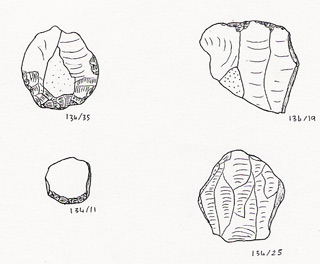
Norfolk SMR: 34184 | Date: 14/02/99
1 Romano-British grey ware, 9 Medieval pottery sherds, 2 Late Medieval / Early Post-medieval. 1 crude flint scraper, 1 'nosed' scraper, 2 retouched flakes, 28 flakes, 147 burnt flints.
"Main raw material is weathered nodules of blackish flint... Probably late prehistoric. High level of burnt flint noteworthy." — Peter Robins, Norfolk Museum Services.