|
The Foot and Mouth Disease Crisis appears over, and the Forestry Commission have reopened Thetford Forest to public access. The Survey Project has ground to a halt in recent years, but I am determined to reactivate the Project, and resume surveys during the forthcoming season. The season lasts from late September 2001, until mid February 2002 (subject to permission from the Forestry Commission). However, the bulk of the surveys will be carried out between late December and mid February. Anyone local who might be interested in coming along, or learning field-walking technique, or how to identify artifacts such as prehistoric struck flints, please mail me at: .
Report - August 19th 2001
|
Foot and Mouth Disease / Web ImprovementsI carried out no SCS surveys this winter - needing to give it a rest for one year. However, surveying of any kind in Thetford Forest is presently impossible. The Forestry Commission have closed the forest off to public access, as a precaution against the present Foot and Mouth Disease Crisis. Meanwhile, I have been busy improving the website. In particular, I have improved the index map on the frames version; have added a page for the medieval ginger jar site; and have replaced the lithics page with a revamped version. Report - March 1st 2001 Congress of Independent Archaeologists, Nottingham University, 21st to 23rd September, 2001The CIA is holding its 2001 Congress asposted above. A number of workshops will be hosted, debating the role of amateur archaeologists in the UK, and their relationship with professional archaeologists. The following introduction to the Congress theme has been posted on the archsoc e-list: In recent decades, amateur archaeology has been crushed by the elephant of official archaeology. Amateurs have lost their confidence, and with rare exceptions, are making little contribution to knowledge. Yet at the same time, the success of programmes such as The Time Team suggests that there is widespread interest in archaeology, while official archaeology - notably the PPG 16 programme - is piling up data that is never used. The next Congress of Independent Archaeologists will look at the relations between official and non-official archaeology and ask: What has gone wrong? Report - January 4th 2001 More WebPages on way...Having been given a small digital pocket camera for Christmas, I have decided to create and launch three new pages to this site, covering earthworks and monuments in the Thetford Forest area. Thetford Forest has an abundant number of earthworks, some largely unknown, some hidden inside dense pine compartments. They range from round barrows of the Early Bronze Age, to the gunflint mines of the early 19th century. It will take me a few weeks to get the first page up, but I believe that it will add a new dimension to this site. I hope to include a virtual tour of monuments within the historical town of Thetford itself. Report - 28th December 2000 Prehistoric sickle found and Update on the Roman Site
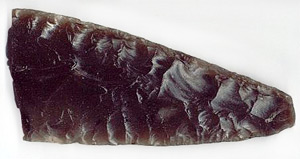
Whilst on reconnaissance in recently cleared forestry compartments in Thetford Warren, I spotted a finely retouched biface in a restock furrow. I interpret the biface as the broken half of a Late Neolithic (or Early Bronze Age), sickle, most probably used to harvest crops or wild cereals. It is a very formal and well made piece, and so may have been valuable as more than just a tool. The raw material is fresh looking, of dark attractive brown-black flint. In addition Ian Hinton continues to search the Roman site. An new interesting find is a dolphin brooch. So far, finds suggest that the settlement existed from circa AD 200 to at least AD 408. The dolphin brooch could suggest earlier activities on the site, back to the late first century. Report - 12th November 2000 |