Archaeo-Blog  


Next blog

February 2000 to October 2000

Late Date for Roman Site

As previously reported, local metal detector enthusiast Ian Hinton has, with permission of the Forestry Commission and Norfolk Museums Service, carried out a metal detection search of the Roman site 32349. He recovered 64 Roman coins (5 silver and 59 bronze), a bronze finger ring, a bronze domestic blade, a broken horse mount, probable metal working slag, a bronze spatula, various iron nails, and more Late Romano-British pottery.

The finds have being despatched to the Norfolk Museum Services for recording and identification. Already, they have decided to record classify the silver coins as a hoard - as they are all of a similar date, and from the same part of the site. The coins run up to the date 408 AD - the year of the last issue of Roman coinage in Britain. This settlement survived very late, and the last Romano-Britons to live there must have witnessed the end of the Empire in Britain - grim days!

Ian also noted that the majority of all of the coins came from one part of the site. Perhaps this was a commercial area, such as a market place. I hope to have scans of some of these metal finds in the future for inclusion on the site.

Report - 29th October 2000


Archives

Later Blogs

Previous Blogs

Contact me!

Guest Book

My Portal

Spam and Chips


This page last updated

2005-12-10
(y-m-d)

Paul Brooker

Another Earthwork Destroyed

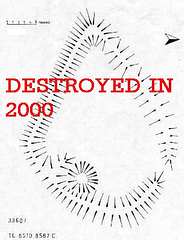
Norfolk 33607 - ploughed across in 2000

A third earthwork in the Warren Woods area of Thetford Warren has been severely damaged through restocking operations. In this case, the earthwork had previously been surveyed and recorded onto the Norfolk Sites and Monuments Record by myself.

It is a small D-shaped earthwork enclosure, and was probably Post-Medieval to Modern, but has not been dated. Its function is unknown - it might have been a sheep pound of some sort. Restocking trenches have been cut through its banks. Only the disturbed area around the small pit inside the south bank has been left intact - no doubt the machinery could not cut over it. It was recorded onto the Norfolk SMR following a submission by myself, as 33607.

Report - 27th October 2000

Click here for larger scan of the ?burner

Can You Identify?

Ian Hinton recently found the following ceramic object in the Forest. Andrew Rogerson of Norfolk Museums Services believes that it might be a 13th century medieval tallow lamp /burner, but had not previously seen one so small, and has doubts. Click on the below thumbnail images for larger scans. Can anyone help offer any suggestions? .

Report - May 16th 2000

Field-walking the Dove Valley

On the 7th May 2000, I joined Suffolk field-walker Tim Holt-Wilson, for a reconnaissance survey on his patch in the Dove Valley. The soils are generally heavier there than here in the Brecks, and it was a chance to compare finds between the two landscapes. We found a surprising high number of prehistoric flint finds, mainly of late (Bronze Age or Iron Age) date, but with a few patinated blade-like flakes, including a denticulated blade.

Report - 8th May 2000

The Project so far

The third season of the research project has come to a close with the onset of the woodlark breeding season. I have completed a mere five surveys this winter, compared with seventeen and sixteen the previous two winters. However, the project will continue. The total area of Thetford Forest surveyed now stands at 164 hectares. Of that, a sample of 51,464 square metres of disturbed surface have been so far walked and searched.

Report - March 2000

Forest-walk 38 - Oteringhythe

I have recently completed my last forest-walk survey of the 1999/2000 season. Forest-walk 38 took place on a forestry compartment, close to the Little Ouse River in Weeting, Norfolk. The survey is of particular interest because it took place immediately next to the site of the Deserted Medieval Vill of Oteringhythe. This settlement was recently rediscovered through documentary research carried out by David Dymond.

I am still processing finds from Forest-walk 38, but the indications are:

  • It has produced the highest lithic density of any of the thirty eight surveys so far - a Very High Density of 18.1 struck flints per 100 square metres. Finds included several scrapers, also flake knives, and hammerstones.
  • It was also the site of settlement during the Iron Age - several flint gritted sherds were collected.
  • I have recovered some Roman ceramics, suggesting nearby settlement during that period. Finds included samien, and Nene Valley mortaria.
  • Much of the survey area formed part of a medieval infield.
  • The survey skirts the edge of the settlement area of the medieval vill. Broken tiles, including peg-tiles, concentrate along the bottom edge of the surveyed area.

Oteringhythe appears to have been an area attractive to settlement throughout several periods. Its recent abandonment appears to be the exception rather than the rule.

Report - February 2000


Previous blog