Introduction and 1995 to 1997 part II
4th Century Romano-British Settlement
- Forestry Compartment: On record
- Norfolk SMR: 32349
- Parish: Thetford
- NGR: On record
- Water: 40 metres from running water
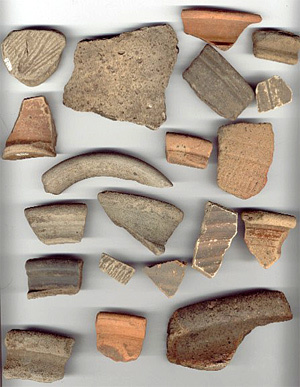
Clusters of late Romano-British pottery, tiles and quern fragments are scattered, often at high density over an area of three hectares. The finds suggest either a 'villa' type estate centre, or alternatively, a small nucleated village settlement, that existed here sometime between the mid 3rd century and the early 5th century. The site had not been previously recorded. Finds suggest at least one substantial building with a tiled roof, domestic activity, including food preparation, and a heating system, possibly for a bath-house.
Pre-Roman finds included:
- 2 flint convex scrapers.
- 3 flint micro-blades.
- 1 flint flake knife.
- 1 flint ?piercer.
- 1 keeled flint waste core.
Roman ceramics included:
- Tegula tile.
- Box-flue tile.
- Grey wares (including possible Nene Valley, and Nar Valley types).
- Calcite gritted (including 'East Midland cooking jar' types).
- Much Hadham ware.
- Pale oxidised ware.
- Nene Valley Colour-coated.
- East Gaulish Samian (only 1 sherd).
- East Anglian Mortaria.
- Oxfordshire Mortaria.
Several fragments of millstone-grit quernstones were also recovered or noted.
As is usual on such sites, the most common pottery consists of grey wares, but sherds of both oxidised and calcite gritted pots were also quite common. Samian is all but absent, with colour-coateds and red slip representing the finer wares, suggesting a late date. One tile was clearly burnt, which might suggest the fate of a building. The existence of this site may indicate that the chain of Roman riverine settlements noted at Hockwold, Weeting etc, extends further up river away from the fen-edge, than has previously been suggested. I have surveyed the site with a metal-detector, but surprisingly made no finds. (Also see site report)
A Riverside Iron-Age Site
- Forestry Compartment: Downham 5013
- Norfolk SMR: 32610
- Parish: Thetford
- Centre on: TL 853 855
- Water: 30 metres from the Little Ouse
Finds included:
- 1 sherd of Beaker (Early Bronze Age) pottery with comb impressions.
- 12 sherds or scraps of ?Iron Age pottery - all dark grey or black, including 1 burnished sherd.
- 1 sherd of Romano-British greyware pottery.
- 5 flint scrapers (mainly informal, including 2 based on cores!).
- 2 flint flake knives.
- 1 patinated unmodified blade.
- 15 retouched or notched flint flakes.
- 4 flint waste cores.
This survey produced the sort of faint prehistoric ceramic site that could easily be missed by the core surface-collection programme with its wide-spaced transects and small sample fraction. The probable Iron Age pottery clustered in a spot near to the river. Flanking it were two slight clusters of flakes, and two slight clusters of burnt flints.
The flints recovered in the area were fresh-looking, with a high degree of informality and miscellaneous retouch, but many were also slim, and blade-like, suggesting perhaps a specialist use of these riverine gravel terraces.
Roman and Medieval Manure Scatters Near Thetford
- Forestry Compartment: High Lodge East 3117
- Norfolk SMR: 32785
- Parish: Thetford
- Centre on: TL 851 830
- Water: 480 metres from the Little Ouse
An attempt was made to survey this compartment, a few years after it had been restocked, presenting difficulties with undergrowth. However, I considered the effort worthwhile, considering the attractive location on riverine slope soils, its proximity to Thetford, and to its middle-Saxon forerunner at Inselford. Most of the finds were recovered from two clear patches, close to the boundary fence with the Golf Course.
Finds included:
- 1 sherd of Rusticated Beaker (Early Bronze Age).
- 1 sherd of ?Bronze Age pottery (possibly a Beaker base-sherd).
- 1 sherd of Iron Age pottery.
- 19 sherds of probable Romano-British pottery (including grey wares and calcite gritted).
- 59 sherds of probable Medieval pottery.
- 1 sherd of Post-medieval pottery.
Lithics were also noted on the compartment, and one convex flint scraper was removed. The ceramics suggest that these slope soils, downriver of Thetford; a place where two rivers meet, and naturally ford - have been heavily exploited time after time, including in prehistory, during the Roman period (possibly 3rd to 5th centuries), and particularly, during the Middle Ages. The only missing period, was the Saxon. The nearest ceramic to this, was a single sherd of Thetford-type ware. I conducted a metal-detector survey of the compartment in 1998 (see Subsidiary Finds No 4, further on).