|
The Roman ceramic finds from site 32349 at Thetford were taken to the Norfolk Archaeological Unit (NAU) at Norwich to be compared with finds from an excavation at Two Mile Bottom. The NAU excavation recovered a large number of unusual ceramics from three kilns at Two Mile Bottom. The ceramics could be described as decorated white wares. Unfortunately, no such ceramics were found in my collection.
Report - February 2000
|
Subsidiary Find 9: Linear Earthwork. This is a low lying earthwork, situated in a clear felled area that had not yet been restocked. It is a linear bank, running alongside but not parallel with fire ride 13. The bank is only slight in places, and is under 50 cm in height. There is no obvious ditch. The bank is 110 metres long. It is situated in Thetford Warren close to the bottom of a dry valley, perhaps it is a remaining section of a longer boundary of uncertain date. The survey was conducted on the 23rd June 1998. Postscript (2000) the bank has since been destroyed by restocking operations. 8: Prehistoric Pottery in Thetford Warren. During 1995 I made a flint collection on this site, and presented the finds to the NLA for recording, who subsequently allocated it the site number 32344. The 1995 finds included a Late Neolithic chisel arrowhead, a laurel leaf, a flake knife, a rod or fabricator, a borer, and eight scrapers, including a button-type. The site appears to offer some potential, being located on a terrace close to the river. As I have improved my collection skills since the initial flint assemblage, I decided to give this site another reconnaissance, to check for ceramics before it is engulfed by vegetation. The reconnaissance was concentrated to the west of the public path, where the flint finds were most fruitful in 1995. The search was conducted between the 21st and 25th September 1998. Vegetation prevented a qualitative survey, and all find spots are approximates only. The ceramic finds would suggest possible cultivation of this area during the Bronze Age, Roman and Medieval periods. The number of prehistoric sherds, despite their poor abraded condition, could indicate settlement. The previous flint finds certainly suggest a Neolithic interest on this site. Peter Robins examined the new flint finds for the NLA, and concluded that there was also a strong indication of Mesolithic activity. Subsidiary Find 7: A 19th Century Bank and a Late Mesolithic Microlith.
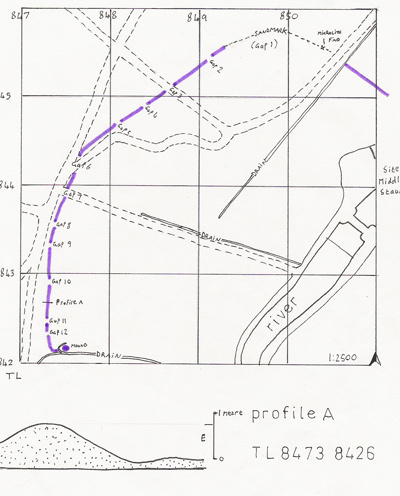
Forestry Comp Downham 5040. This represents a survey of a linear earthwork, that originally curved around for 700 metres, enclosing an area of gravel terrace and valley bottom peat fen adjacent to the Little Ouse River. It is shown on O.S as a dark line, running around an area named 'New Plantation'. The boundary is not shown on the 1805 Thetford Enclosure Map (held at the West Suffolk CRO), but is shown as an area of plantation on the 1906 O.S 1:2500 map. Subsequently, the boundary bank does appear to date to the 19th century, and is simply a woodland boundary bank. Forestry operations are damaging the bank. In recent years, a 130 metre long section has been totally destroyed where it crossed a part of compartment 5040 that has been restocked, leaving only a sand-mark. This despite the restocked area not being destumped. A further 11 gaps have been made in the bank: 3 for paths, and 8 for access during past forestry operations. Although this earthwork is of minimal archaeological value, the survey does show how unrecorded earthworks can be damaged, even in non-destump areas of the forest. A microlith was recovered from the sand-mark, where the 130 metre long section of bank had been removed, at TL 8504 8455. Peter Robins provides a description of this find below. Microlith: Obliquely blunted with ancillary RHS dorsal retouch. Unusually thick near to the point, which is incomplete. Retouch extends to the full length of each lateral edge, with slightly more invasive scars running up to the crest of the projection on the dorsal face. It is not clear whether the tip of the point is broken or has been left unfinished. Mesolithic (probably Later Meso). Subsidiary Find 6: A Small Earthwork Enclosure. This is a small D-shaped enclosure bank, with a possible narrow entrance in its north-east corner, and a small pit incorporated into the south-east bank. t enclosures an area of less than 20 metres by 18 metres. Banks are all under 40 cm in height. Vegetation around the small pit is lush. The enclosure is situated in Thetford Warren, 225 metres away from the Little Ouse River, and adjacent to a public-right-of-way. The earthwork probably represents an undated sheep pound or enclosure. Forest-walk 37
3 sherds of pottery No post-medieval / modern finds. 74 stints were walked across this non-destump compartment on 22/23 January 2000. Survey conditions were good to average, and the viewing width was set at 110 cm. The percentage of flake utilisation is very low here, perhaps suggesting that flint was knapped here more often than it was used. A slight cluster of burnt flints was detected at TL 8376 8753 A. Forest-walk 36 No post-medieval / modern finds. 44 stints were walked across this non-destump compartment in December 1999. Survey conditions were good to average, and the viewing width was set at 110 cm. Lithic Sample Size = 27 Forest-walk 35 A little slate, tile and brick fragment found. Thirty eight stints were walked on this destumped compartment. Viewing was set at 110 cm. The presence of Roman manure scattered ceramics on most of the forest-walks in Kings Forest suggests that settlement probably existed somewhere in the vicinity. Mixture of grey and black flint, some slight blue/grey patination. Difficult to seperate from natural grey flint. Suggestions of reworking and poor quality assemblage suggests probable mainly Later Bronze Age (?) - Notes by Colin Pendleton, Suffolk C.C. Lithic Sample Size = 34. Sample Area = 836 M² |